Monday, November 10, 2008

Building Strategies


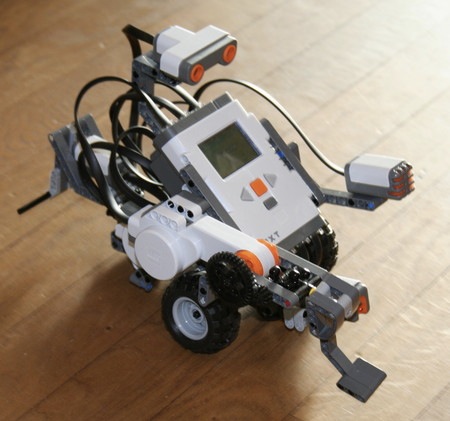
To build the robot, i was thinking of having the actuall NXT horizontal on the robot. The robot will have to be light enough so the robot does not jump like a frog. Tracks are a good application too.

The sensors have to be rearanged so they are all fully functional. This means that the touch sensor has to be at the front for it to actually touch the wall but the ultrasonic has to be at the front aswell. For the robot to actually be in the box, the light sensor has to be at the back. If we are not lucky enough to miss the cans, the cannon will have to be in the middle, but again nothing in front of it.

Wednesday, November 5, 2008

Geometry of LEGO (made in denmark)


That 1*1*1* lego brick they have always been talking about? Yeah that one. It is not acually a1*1*1 brick, it is a 6*5*5 lego brick. This is without the stud. The first actual lego brick was 2*4*1. It is actually the ratio that is important if you divide 9.6 by 8 to get 1.2(the height corresponding to 1.2 times the width.. this is because a studs width corresponds to 8mm and the hight of the brick, without the stud, to 9.6mm. that is the hard way. The ratio is easier to remember whe it is like this; 6:5. Whats the use of all this though? You dont want to make your robot too heavy with all this math anyway. To make a good robot, you have to make it strong and light weight. Impossible you say, no you can! You use studded beams, plates and pins and make a chassis. then you cross-brace it. With some of the new models os plates and pins, you could make an even ligher and stronger one. Ok here comes the math again. You must know the Pyagathorean Theorem? If you dont, then it is simple to learn. A2+B2=C2. a=base and b=height. There are only certian combos that work so I am going to show one for you to know what works and what doesn't. A=13 and B=26 13*13+26*26=c2--169+676=c2--169+676=845--square root 845=29. this works because of the whole number so c=292. You get the picture. oh and one last thing, liftarms. there are so many applications for these babys. You could connect them, make them work for a sensor or make them activate one themselves. There is so much more but I have to go now bye!

Field of view


For this experiment, we were testing on how far and wide the ultrasonic senor can 'see'.

To do this, we took a solid object and made the robot sense the white board eraser------------------------------------>

Until the robot would show question marks. Then on every 10 cm line till the end, we saw how wide the whiteboard eraser would go before the robot showed question marks again. We then put a mark on where the eraser was.

The Obstacle Course

The objective:

Your team will need to design and build a robot that uses all 4 sensors. You will then need to program your robot to maneuver through the obstacle course in the quickest time.


To make it move I will have to start with a clap. this is easy. To make it stop in the box is a little harder. I think I will have to put the light sensor on the back of the robot instead of the front. To make it wait for five seconds, I will simply just put in a wait block. The whole course program will be set up in the simple programs with reset blocks and extra trinkets that will make its run smoother. The cans are not liable to be easy though. They will be placed randomly and as I can't go out of the tape i cant make the robot turn a certian way. This means i will have to make the cans go away....